Driving Faster than Language
Internalized confidence, predictive cognition, and why expert drivers often cannot fully explain what they know

The Quieting Narrator
I’ve been thinking a lot lately about internalized confidence while driving, and how strange human learning actually is. Not confidence in the motivational poster sense. More the kind where actions stop requiring constant conscious supervision.
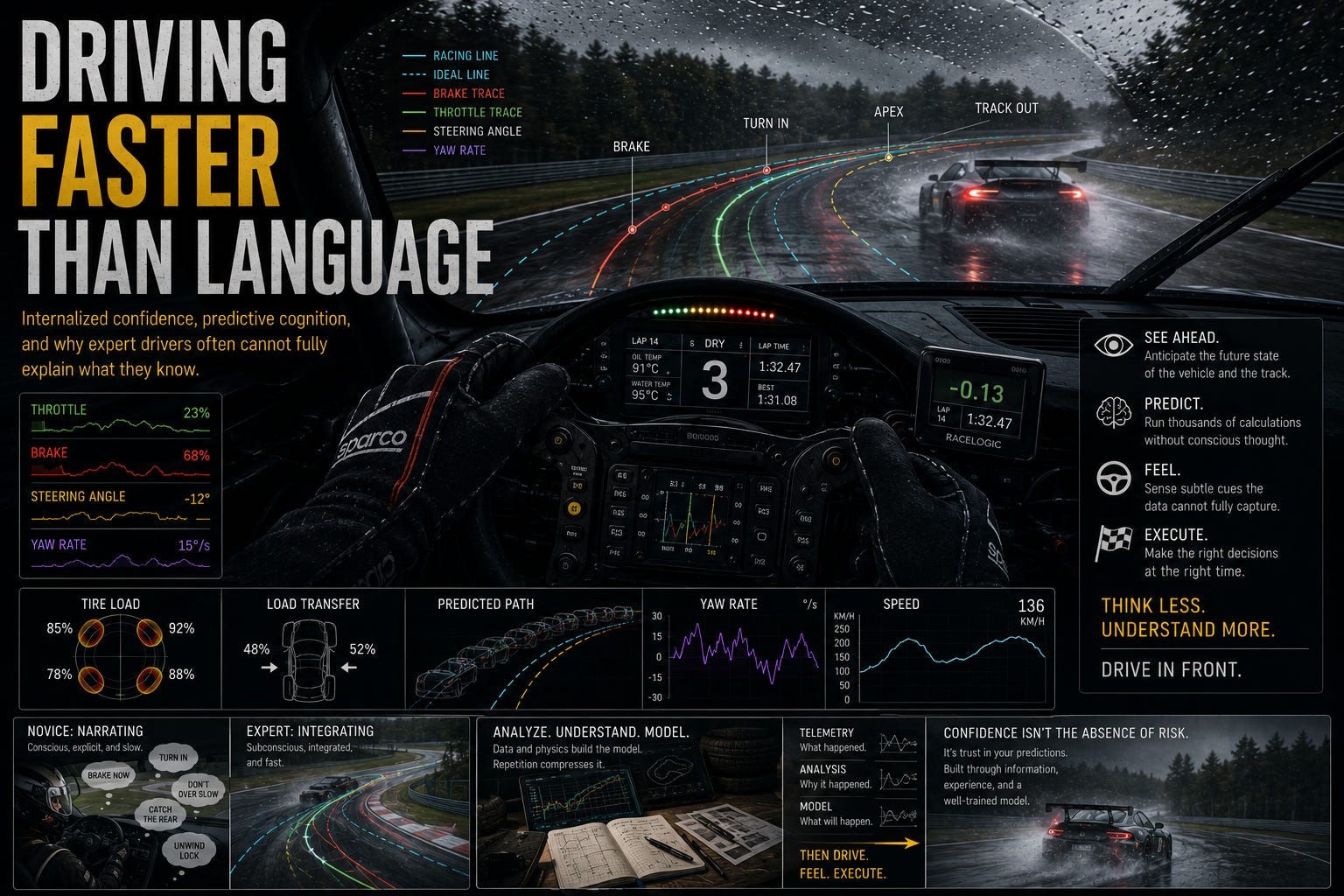
Most very skilled drivers are not actively narrating every single thing they are doing in real time - nowhere close. “Brake now. Turn in now. Catch the rear. Unwind lock. Don’t over-slow entry.” Those types of active coherent word-based thoughts are usually not part of the equation. Some do this - and you see this sort of thing a lot in esports / simulator driving, even at the very highest level, but for most it’s different.
The interesting thing is that people sometimes mistake this absence of conscious linguistic self-commentary for the absence of thinking entirely, but that is very obviously not what is happening. In many cases the brain is likely processing more information, not less. It’s just doing it procedurally instead of verbally. The nervous system is still predicting grip, estimating load transfer, tracking yaw behavior, filtering vibration and tire feedback, building expectations for surface conditions, and continuously correcting errors. It’s just not narrating all of it.
I think that distinction matters a lot, because modern culture tends to privilege the kinds of cognition we can consciously explain. If you can articulate it cleanly, quantify it, put it into a diagram or spreadsheet, people tend to treat that as “real” understanding. But motorsport exposes the limits of that assumption very quickly.
There are drivers who can recite tire models, damper curves, and slip angle theory while struggling to execute consistently at the limit. There are also drivers who could not derive a tire force equation if you put a gun to their head, yet somehow immediately understand what a chassis wants underneath them. Neither of those people is “fake”, or “wrong”. They are simply operating with different mixtures of explicit and procedural cognition. And before anybody takes this into anti-engineering territory, that is not where I’m going with this at all.
Physics matters enormously. Data matters enormously. Explicit understanding matters enormously. In fact, some of the best drivers I know are extremely technical people. But what fascinates me is that high-level execution often relies heavily on compressing analytical understanding into lower-latency predictive systems that operate below conscious narration. In engineering terms, it is as though repeated exposure trains a massively parallel predictive controller that eventually stops requiring constant top-level supervisory input. There’s a parallel between this and how AI functions, but I digress, and that’s a story for another day…
Licensing Day
Years ago, when I took my Michigan motorcycle endorsement test, I volunteered to go first during the riding assessment. Very “me” behavior. In front of 30 people no less. On the very first exercise, I put my foot down unnecessarily and lost three points immediately. You could only lose fifteen.
I was so frustrated and irritated with myself over making such a dumb mistake that something interesting happened afterward. I flipped a switch. I basically stopped consciously thinking about the test entirely and just rode the motorcycle. The rest of the assessment became almost automatic, and I ended up with a perfect score beyond the initial penalty, along with compliments from the instructors about my bike control.
What fascinates me looking back is that the skill was obviously already there before I put my foot down. The mistake did not magically create the competence. If anything, it may have removed part of the cognitive overhead surrounding the competence. I stopped auditing myself in real time. I stopped trying to consciously prove I could ride the motorcycle, and simply rode it.
When Thinking Gets in the Way
I think almost anybody who has driven at a high level has experienced some version of this. You have sessions where you are trying incredibly hard to “drive correctly,” consciously monitoring every action, every brake point, every steering input, every tiny mistake. Then you have other sessions where you simply settle into rhythm and suddenly become smoother, calmer, and faster. Ironically, and most often, the harder you try to consciously supervise every detail during execution, the more bandwidth you consume doing so.
This becomes especially interesting from a systems perspective because conscious verbal reasoning is relatively slow and serial in nature. High-speed vehicle control is not. Vehicle dynamics are massively parallel and continuously evolving. Tire force generation, load transfer, transient damping behavior, aero balance migration, yaw acceleration, steering phase lag, brake release timing, and surface friction estimation are all evolving simultaneously and continuously. A driver consciously narrating every one of those processes in real time would be overwhelmed almost immediately. So instead, humans build compressed internal models. That is the part I find fascinating.
Building Internal Models
What intrigues me most is watching elite drivers at unfamiliar tracks or in unfamiliar cars. Some of them seem to almost immediately understand not only where the track goes, but how the car is likely to behave there. Different pavement, different camber, cold grip, standing water, different tire construction, aero balance changes, surface texture, transient understeer on entry, the way a curb loads the chassis, how quickly a rear tire “takes a set.” They often intuitively know. I am not particularly good at this…hence the fascination. I instead ease up to it, and it takes me more repetition and experimentation than is ideal when coming up to speed at most tracks.
I do not think this is a “sixth sense”, magic, or mysticism, or even a “gift” or “talent”. I think it is highly trained predictive cognition operating below constant conscious narration. And the level at which people do this varies by the individual and even by the specific situation in each individual. We all know competent drivers that cannot left foot brake, or heel / toe, or trail brake very well, or who struggle in the wet. The newer driver often experiences driving as isolated instructions in most situations: brake here, turn here, track out there. The elite driver often appears to perceive the entire vehicle as a continuously evolving dynamic system.
That difference matters. The really good ones are not merely memorizing corners. They are recognizing relationships and invariants between systems. How weight transfers longitudinally and diagonally. How tire load sensitivity alters available grip. How quickly the chassis accepts a yaw moment. How certain surface textures correlate with μ variation. How steering release timing changes rear tire workload. How curb geometry excites suspension modes. How aero platform migration changes front response at speed. And importantly, many of them cannot fully explain what they are doing. That part fascinates me too. Humans are capable of becoming deeply competent at things they do not fully understand symbolically. Sometimes the nervous system learns first, and language catches up later.
Why Some Fast Drivers Cannot Coach
This is also why elite athletes are not automatically elite coaches. I was just discussing this with a motorcycle racer transitioning into cars that I was instructing at a track day this past week, and he described a recent coaching experience with a “fastest guy at the track” type who could not successfully coach almost anyone - himself included - a guy that I personally found IMMENSELY coachable - one of the best students I’ve ever had. And as odd as that sounds, it makes perfect sense to me.
Some people learn through equations and telemetry. Some through sensory feel. Some through visuals. Some through rhythm. Some through repetition. Some through metaphor. A good coach is often less about possessing knowledge and more about being able to translate between cognitive frameworks. And honestly, genuinely effective coaching requires a level of empathy that I think often gets overlooked in technical environments. Good coaches find common ground. They figure out how the other person internally models the problem, then build a bridge from there. They are not merely transmitting information. They are translating cognition.
And that also requires humility. I think genuinely effective coaching is fundamentally rooted in the empathy I mentioned above. Not softness, but the ability to understand how another person is perceiving the problem. The ability to see things from their perspective, be “in their shoes”. Good coaches find common ground. They understand that different drivers process information differently, build confidence differently, and internalize vehicle behavior differently.
Toxic or, more generally, ineffective coaches often do the opposite. They leverage ego. They want to impress. They can confuse intimidation with authority and assume that demonstrating superiority is the same thing as teaching. Effective coaches are usually much more humble than that. Their focus is not on displaying expertise. It is on helping another person build understanding and confidence.
The best coaches I have personally encountered are usually not trying to impress the student with how fast they are or how much they know. They are trying to understand where the student currently is, what signals they respond to, what fears or misconceptions are interfering, and what language actually allows the student to progress.
In some cases skilled drivers have never had to consciously deconstruct their own process in the first place, so frustration emerges when another driver cannot simply “feel it” the same way they do. But effective coaching is rarely about making the coach look impressive. It is about making the student feel understood. I think this is also why certain coaching phrases sound almost absurdly vague from the outside.
“Wait for the car.”
“Let the rear come to you.”
“Feel the tire take a set.”
“Don’t rush the platform.”
Those statements sound imprecise, but they are often attempting to interface with embodied cognition rather than symbolic analysis. They are describing highly dynamic systems that operate faster than language comfortably does.
And yet the engineering side still matters enormously. This is where people sometimes oversimplify things into false binaries: feel versus science, intuition versus engineering, natural talent versus technical understanding.
I do not think that is what is happening at all. The strongest drivers I know usually possess both: deep procedural intuition during execution, and analytical frameworks during reflection and refinement. Yet there are a very many people who find themselves in the position of driver coaching, both informally and formally, who cannot let go of that binary. These are the guys who “drive around setup issues”, or alternatively, fixate too much on 0.1deg of camber change as the solution to an issue.
The analysis builds and sharpens the model. The procedural system executes the model. Conscious intervention ramps back upward when anomalies appear, conditions change, or learning stalls.
The Sim Racing Question
This whole topic has also made me think about something else I have noticed in recent years: the increasing number of young drivers who transition from esports and sim racing into autocross and track driving with shocking speed and confidence. As somebody who learned the “old way” first through real vehicles, that progression is fascinating to me.
Historically, many drivers implicitly treated tactile sensation as the foundational language of driving. Tire vibration, steering effort, vestibular loading, chassis movement, fear response, engine noise, and physical consequence were inseparable from the learning process itself.
Then sim racing arrives and younger drivers begin demonstrating something deeply interesting: many high-level competencies appear to transfer extraordinarily well even when large portions of tactile input are absent. That forces an uncomfortable but fascinating question: How much sensory information is actually required to train high-level predictive driving models?
Sims preserve many of the things that may dominate higher-order driving cognition: visual timing, spatial prediction, line optimization, yaw anticipation, steering phase relationships, braking timing, trajectory management, and iterative experimentation. In other words, they preserve much of the predictive architecture of driving even while stripping away many tactile channels.
That may explain why sim-native drivers can adapt so quickly once they enter real cars. The higher-order predictive framework already exists. They more so simply need to “calibrate” additional sensory channels and consequences. From a controls perspective, it is almost like the state estimator is already trained, and the real-world tactile system becomes an additional refinement layer rather than the foundation itself. That possibility is deeply interesting.
Older generations often built intuition through tactile immersion first, then gradually abstracted generalized predictive models from it. Sim-native drivers may be developing generalized predictive frameworks first, then attaching physical sensation onto them later. Those are almost inverted developmental pathways.
At the same time, I do think it is important not to oversimplify this into “sims replace real driving.” Real-world tactile and vestibular cues still matter enormously at the highest levels, especially near adhesion limits, during transient conditions, in endurance scenarios, and under unusual grip environments. The strongest interpretation is probably not that tactile feedback is unnecessary, but that higher-order predictive frameworks may be trainable independently to a much greater degree than many of us previously assumed.
Signal Purity
I have also thought about this in the context of recent comments from Max Verstappen regarding front wheel drive cars and karting. On the surface, statements like “this doesn’t translate” can sound dismissive or overly simplistic. But I suspect there is something deeper underneath them.
Despite what Max said, karting absolutely teaches valuable things: racecraft, momentum preservation, reaction speed, line sensitivity, proximity comfort, and reflexive correction. But karts also operate under a very different dynamic regime than modern race cars. No suspension, very different yaw behavior, different transient loading characteristics, different tire behavior, different compliance effects, and almost no meaningful aero platform management. Similarly, front wheel drive cars train certain predictive assumptions that may diverge substantially from rear-drive or high-downforce vehicle behavior.
A top-level driver may subconsciously categorize certain learned behaviors as highly transferable and others as potentially contaminating to refined predictive models. That does not necessarily mean those disciplines have no value. Quite the opposite. Many elite drivers came from karting and lower-grip platforms. But transferability may be partial and asymmetric rather than universal. The more elite somebody becomes, the more they may optimize not merely for learning volume, but for signal purity. And maybe that is ultimately what expertise really is. Not the absence of thought. But the compression of thought into something faster than language.
This kinda reminds me of Noel Burch's "Four Stages Of Competence" framework.
1. Unconscious Incompetence - you suck, and you don't know why
2. Conscious Incompetence - you suck, but at least you can articulate the reasons why
3. Conscious Competence - as long as you think about your actions, you can do okay
4. Unconscious Competence - you do just fine even when not talking yourself through it
In that 4th stage, your reactions have gotten faster than your language.
I personally have the same fears as I do on the sim as I do in real life suprisingly. I’m more comfortable feeling the mistake happening in real life then with out it on the sim. I think some peoples mental model has evolved overtime from driving on different tires, different surfaces, and near the limit to where adapting to changing circumstances is already apart of their mental make up rather they know it or not. Now I wonder when a driver has a bad experience at a track or in the wet and then notion creeps in “im just not good at xxx” does the mind start switching more to conscious behavior and reinforcing those thoughts?